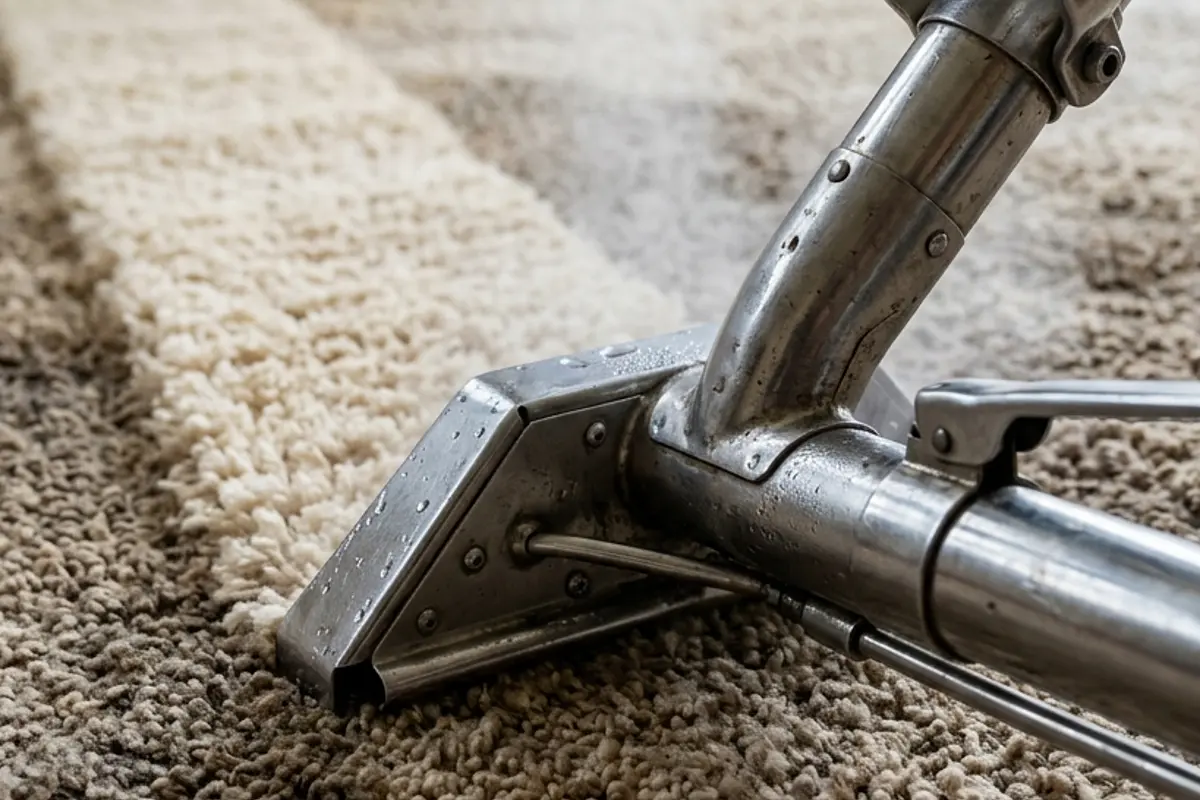
Almost every permanent mark we are called out to look at started as a removable one. Somebody spilled something, panicked, and scrubbed — and scrubbing does two things that cannot be undone. It drives the spill from the surface of the fibre down into the foam, where no surface treatment will ever reach it, and it abrades the fibre itself so that the patch reflects light differently to everything around it. That second effect is why some "stains" stay visible even after the colour has gone: you are looking at damaged texture, not residue. Blotting from the outside of the mark inwards, pressing rather than rubbing, is the entire technique, and it is worth knowing before the next glass goes over.
The second thing that sets stains is the wrong chemistry, confidently applied. Stains fall into families and the families want opposite treatments. Tannin marks — wine, tea, coffee, fruit juice — respond to a mild acid. Protein marks — milk, blood, egg, vomit, pet accidents — need an enzyme and are set hard by heat, which is why steam on a protein stain is a mistake you cannot take back. Oil and grease need a solvent. Dye stains need a reducing agent and often will not shift at all. A general-purpose bottle from the supermarket is usually alkaline detergent, which handles none of these well and leaves behind a sticky residue that pulls fresh soil into exactly the spot you were trying to clean. That is why a home-treated mark so often reappears as a darker ring a month later.
Then there is the fabric's own opinion, which overrules everything above. The care code decides what may be used at all: W allows water-based work, S is solvent only, WS takes either, and X means nothing wet may touch it. On an S-code fabric a water-based spotter leaves a ring far uglier than the original mark. On linen or viscose, over-wetting a small area causes browning that spreads well beyond where the spill was. Our technicians find the code, test in a hidden place, and work the whole panel to its seams rather than dabbing at the middle — because a wet patch that dries on its own leaves an edge, and that edge is a new stain in the shape of your good intentions.